The majority of homes were not built with significant disabilities in mind. For NDIS participants who live with extreme functional impairment, that gap is not just inconvenient. It is a daily barrier to safety, independence, and quality of life. Specialist Disability Accommodation (SDA) exists to close that gap.
This guide covers everything you need to understand about SDA accommodation: what it is, who qualifies, how SDA funding works, the four design categories, and how to find the right SDA provider in Perth, WA. Whether you are a participant, a family member, or a support coordinator, this guide gives you clear answers in plain language.
Achieve Disability Care supports NDIS participants across Perth, WA, through every stage of the SDA process, from eligibility assessment through to relocation.
What is Specialist Disability Accommodation (SDA)?
Specialist Disability Accommodation is purpose-built or significantly modified housing funded through the NDIS for participants who require specialist physical features in their home. SDA accommodation is not general rental housing. It is designed to reduce the physical support burden, improve safety, and create an environment where a participant can live with greater independence.
SDA funding covers the cost of the dwelling itself. It does not fund the support services delivered inside the home. This is one of the most common points of confusion in the NDIS: SDA and support services are separate. They are funded separately. And they require separate approvals.
SDA vs SIL vs STA vs ILO
These four NDIS accommodation types are frequently confused. Here is a straightforward breakdown, followed by a comparison table.
- SDA (Specialist Disability Accommodation): The physical home, funded for participants with extreme functional impairment or very high support needs.
- SIL (Supported Independent Living): The support workers and services are delivered inside a home. SIL is not the housing.
- STA (Short-Term Accommodation): Temporary accommodation, often used for respite home or trial stays, funded separately in an NDIS plan.
- ILO (Individualised Living Options): ILO is a flexible arrangement designed around a person’s individual goals, combining informal and formal supports.
Type | What It Covers | Who It Is For |
| SDA | The physical dwelling with specialist features | Participants with extreme functional impairment or very high support needs |
| SIL | Support workers and daily living assistance inside the home | Participants who need on-site support to live independently |
| STA | Temporary accommodation for respite or trial stays | Participants needing short-term away-from-home support |
| ILO | A flexible, goal-driven living arrangement using informal and formal supports | Participants who want a highly personalised living option |
SDA and SIL are regularly used together. A participant may live in SDA housing and also receive SIL funding for on-site support workers. They are separate budget lines within an NDIS plan, and each must be approved individually.
Who is Eligible for SDA Funding?
SDA eligibility criteria are specific. The NDIS funds SDA only for participants who meet one of two conditions: extreme functional impairment or very high support needs.
Extreme functional impairment refers to severely limited capacity across multiple life areas as a direct result of disability. Very high support needs typically involve requiring significant active overnight support or complex personal care that cannot be reasonably delivered in standard housing.
To access SDA funding, participants must provide supporting evidence. This usually includes a detailed occupational therapist (OT) assessment, relevant medical reports, and documentation of current housing circumstances. The OT report is critical: it must clearly connect the participant’s functional capacity to the need for specialist housing features. A vague or generic report is one of the primary reasons SDA requests are delayed or rejected.
SDA eligibility is not automatic with an NDIS plan. It requires a formal request, strong evidence, and approval from the NDIA.
SDA Funding Explained
SDA funding covers the cost of providing and maintaining specialist housing. The NDIS pays SDA funding directly to registered SDA providers, who use it to offset the cost of building and maintaining SDA houses.
What SDA funding covers: the physical dwelling, specialist design features, and the ongoing maintenance of those features.
What it does not cover: personal care, support workers, daily living assistance, allied health, or community participation. Those supports are funded separately through SIL, core supports, or capacity-building budgets in an NDIS plan.
Participants do not receive SDA funding as a direct payment. The funding flows to the registered provider and is reflected as an approved budget line in the participant’s NDIS plan.
Types of SDA Housing: The Four Design Categories
The NDIS recognises four design categories for SDA accommodation. Each is designed for a different level of need.
Improved Liveability SDA
Improved Liveability SDA is designed for people with sensory, intellectual, or cognitive impairments. Improved liveability homes include features such as better lighting, contrasting fixtures, and layouts that reduce confusion and support safe navigation. This is the most widely available SDA category.
Fully Accessible SDA
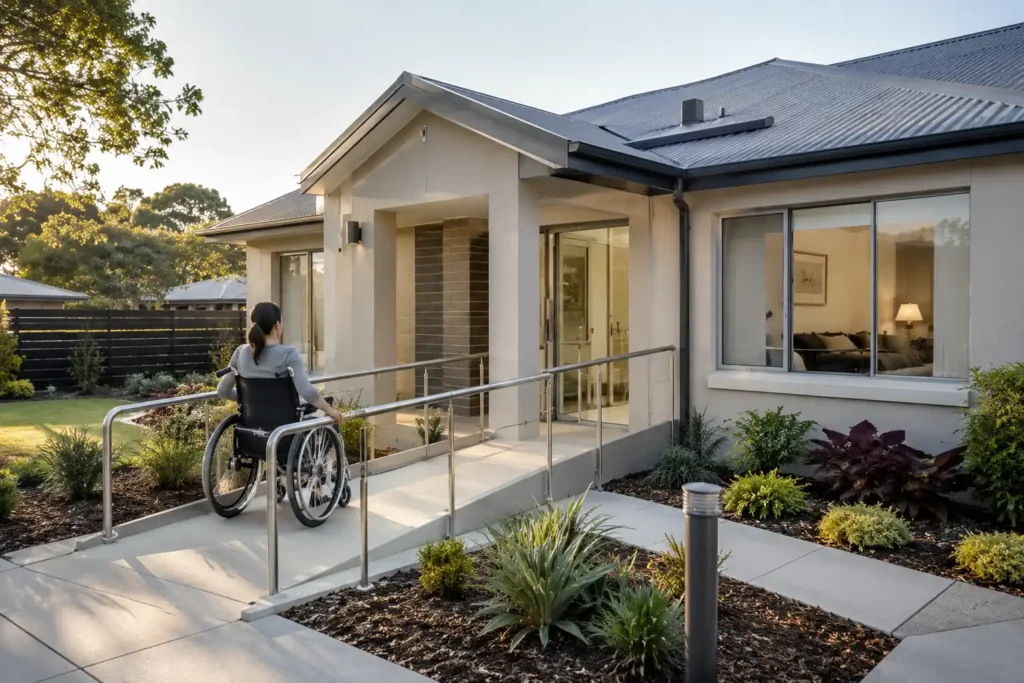
Fully accessible SDA is built for people with significant physical disabilities. Fully accessible homes include wider doorways, ceiling hoists, roll-in showers, and step-free entry throughout the property.
High Physical Support SDA
High physical support SDA is for people with the highest physical support needs, often requiring assistive technology and overnight onsite support. High physical support SDA homes include structural provisions for ceiling hoists, emergency call systems, and back-up power for life-sustaining equipment.
Robust Housing
Robust housing is designed for people whose behaviour may put themselves or others at risk. Robust SDA homes are built with reinforced materials and layouts that reduce the risk of injury while supporting greater independence over time.
Choosing the right category depends on the participant’s functional assessment, their goals, and the type of support they require at home.
Is Respite Care the Same as STA?
While the terms are often used interchangeably, ‘respite’ describes the purpose (giving carers a break), while ‘short-term accommodation’ is the funding category used by the NDIA. In 2026, the national disability insurance agency (NDIA) emphasises that these stays must focus on skill development and maintaining the sustainability of your home-based care.
SDA Building Types and Living Options
SDA houses come in several formats: individual dwellings, apartments, villas or duplexes, and shared homes.
Individual dwellings offer maximum privacy and suit participants with complex or very high support needs. Apartments offer location flexibility and accessibility in urban areas close to services and transport. Shared homes allow two to four participants to live together, reducing isolation and sometimes support costs. Villas and duplexes offer a middle ground between independence and proximity to neighbours.
No single format suits everyone. The choice depends on the participant’s goals, support intensity, and personal preferences.
What Supports Are Included in SDA Homes?
SDA covers the home. Not the support inside it.
Most SDA residents also access SIL (Supported Independent Living), which funds on-site support workers for daily living tasks. Some participants receive SDA alongside personal care, community participation funding, or allied health services. These are coordinated separately and must align with the participant’s approved NDIS plan.
A support coordinator plays an important role here: ensuring that SDA housing is matched with the right mix of services so that nothing falls through the gaps.
How to Apply for SDA: Step-by-Step
- Confirm your NDIS eligibility and whether SDA is appropriate for your level of need.
- Obtain a functional assessment from a registered occupational therapist.
- Gather supporting medical and clinical documentation.
- Submit an SDA request at your next NDIS plan review or planning meeting.
- Wait for NDIA approval and SDA inclusion in your plan.
- Search for suitable SDA housing with a registered SDA provider in your area.
- Arrange a property inspection or trial stay before committing.
- Coordinate your move-in with your support coordinator and support team.
The process takes time. Starting early and working with an experienced support coordinator reduces delays and avoids the need to resubmit.
How to Find the Right SDA Provider in Perth, WA
Finding a quality SDA provider in Perth requires more than a web search. Ask prospective providers about their registered design categories, available properties, vacancy timelines, and how they coordinate with SIL providers. Not all SDA providers manage both housing and support services; knowing this upfront avoids complications later.
Inspect properties before making a decision. Ask about maintenance response times, emergency protocols, and how the provider handles plan reviews or changes in support needs.
Achieve Disability Care operates in Perth, WA and supports NDIS participants from initial SDA enquiry through to move-in. Their team coordinates SDA housing with other NDIS services to create a connected support environment, rather than leaving participants to manage multiple providers independently.
Benefits of Specialist Disability Accommodation
The SDA benefits extend well beyond the physical building. Participants in suitable SDA housing gain improved safety at home, reduced reliance on support workers for basic physical tasks, and greater independence in daily routines. These are practical, measurable improvements in quality of life.
SDA housing also supports social inclusion by placing participants in communities where they can access services, public transport, and peer connection. For families and carers, appropriate SDA accommodation reduces long-term pressure and creates stability for everyone involved.
Why Choose Achieve Disability Care for SDA in Perth?
Achieve Disability Care brings local knowledge and end-to-end support to every SDA engagement. Their team understands Perth’s housing landscape and the specific requirements of the NDIS in Western Australia.
From evidence gathering and plan submission to property matching and move-in coordination, Achieve Disability Care supports participants at each stage. They also integrate SDA with SIL and personal care services, so participants receive a connected support experience rather than managing separate providers independently.
Contact Achieve Disability Care to discuss SDA options in Perth and find out which design category and housing type suits your needs.
Experience Premium Specialist Disability Accommodation
At Achieve Disability Care, we pride ourselves on being a trusted NDIS service provider in Perth. Our specialist disability accommodation options are designed to feel like a getaway, not just a service.
Frequently Asked Questions





2 Responses