Flour on the table. A couple of laughing voices. Someone showing a friend how to fold pastry the right way.
It looks like nothing. But that half hour is doing three jobs at once: building a routine, practising a skill, and forming a friendship. That’s what good NDIS group activities actually look like, not a program described on a funding page, but a room full of small, real moments.
If you’ve seen “group activities” or “group and centre activities” listed in an NDIS plan, you’ve probably wondered what that actually means once it leaves the paperwork. Here’s the plain version.
What Counts as NDIS Group Activities
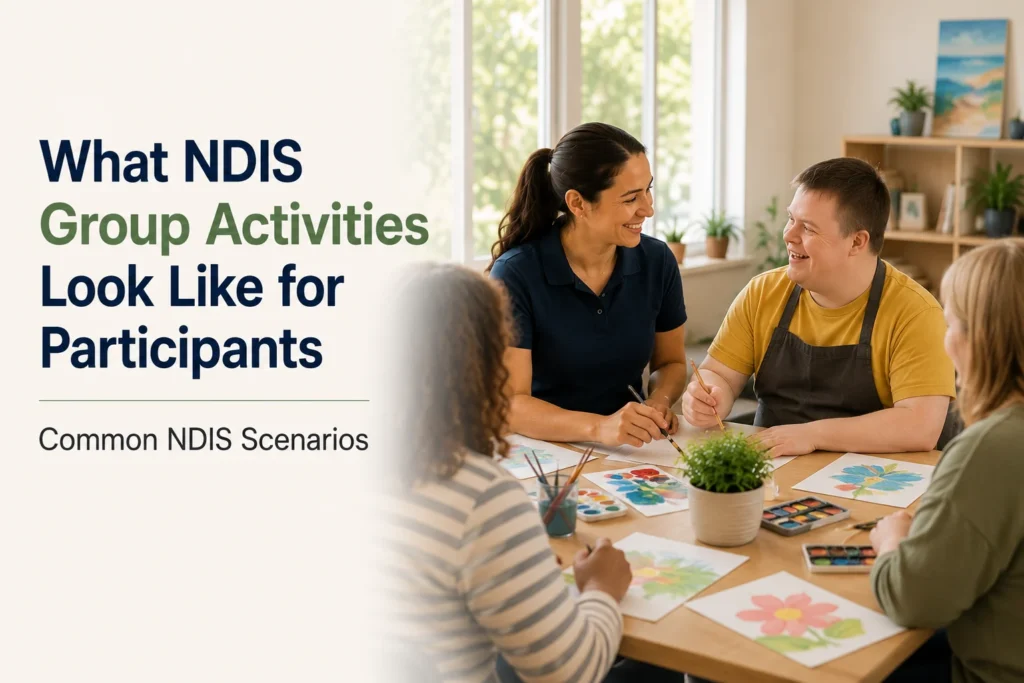
NDIS group activities are supervised, regular sessions where participants join others for social, recreational, or skill-based programs. Most run in a community setting or a dedicated centre space.
The format shifts depending on the provider and the group. Some sessions are small and focused: one activity, like cooking or art, run with a handful of participants. Others take the group out into the world instead, a café visit, a park session, a local event.
What ties them together isn’t the activity. It’s the company. You’re not working through a task alone with one support worker beside you. You’re doing it with other people, trading conversation, effort, and the occasional bad joke along the way.
That distinction carries more weight than it first seems.
Why NDIS Group Activities Matter
Independence doesn’t come from a single lesson. It builds through repetition, in real settings, with real people around.
That’s the actual value here. Group activities let participants practise the same skill again and again. The setting feels social, not clinical. Cooking with others isn’t the same as cooking alone. Planning an outing as a group means negotiating, waiting your turn, adjusting when someone else wants something different. None of that comes from a worksheet.
There’s a simpler benefit sitting underneath all of it too: connection. Group settings create low-pressure chances to meet people and build friendships. For a lot of participants, that social layer of an NDIS plan matters just as much as any skill-building goal written into it.
Confidence grows at place.
Short line, but it holds up. Trying something new is easier next to people who know what a clumsy first attempt feels like. It swaps “I need to get this right” for “we’re working this out together.” That shift changes how someone shows up to the next session too.
Group activities also tend to sit inside broader plan goals easily. Community participation, social skill development, and everyday independence are all areas the NDIS treats as legitimate, fundable goals. These goals often fit naturally into a plan, and activities like these commonly sit within Core Supports, the everyday funding category for support and services, without needing to be dressed up as formal therapy.
What an NDIS Group Activities Session Might Look Like
No two sessions look exactly the same. But good programs usually follow a clear, supportive rhythm.
- Arrival and check-in
Participants arrive, settle in, and get a simple idea of what the session will involve. Knowing what to expect can help people feel more comfortable.
- A clear activity focus
Most sessions centre on one main activity, such as cooking, gardening, art, music, or a community outing. The aim is to give people something meaningful to do together.
- Built-in social time
Conversation is part of the session, not an extra. This might happen during a shared task, over a meal, or in a group game.
- Flexible support during the session
Some participants may need extra guidance. Others may need a quieter moment. Good staff adjust support without making anyone feel singled out.
- A simple wrap-up
Many sessions end with a quick reflection on what worked, what participants enjoyed, and what they might try next time. That helps turn one session into ongoing progress
The best sessions do not feel rigid. They feel relaxed, social, and well supported.
What to Look For in a Good NDIS Group Activities Program
A few questions separate a strong program from an average one.
- Does it connect to real goals? Sessions should tie back to something that actually matters to the participant: confidence, friendship, a specific skill. Not filler dressed up as programming.
- Is there genuine choice? Participants should have some say in what they join, not a fixed roster handed to them with no input.
- Is the setting safe, in more ways than one? Physical accessibility matters. So does emotional safety. Staff should know what to do if a session starts to feel like too much for someone.
- Are staff actually trained for disability support? Not just activity planning. That difference shows up quickly once something unexpected happens mid-session.
- Is there real variety over time? Social sessions, skill-building, community outings, a good program mixes these rather than running the same format on a loop.
- Does it get people out into the community, not just into a room? Centre-based sessions have their place. But a program that never leaves the building is missing something.
Ask these whether you’re choosing a provider for the first time or reviewing a support that’s already running.
NDIS Group Activities as Part of a Bigger Picture
Group activities sit inside a wider set of community participation supports available under a plan. For some participants, they’re a small, valuable slice of the week. For others, they carry more weight in building routine and confidence.
Either way, they work best when chosen on purpose, not tacked on as filler. A session tied to a real goal, run by people who can adjust on the fly, makes a genuine difference over time. And that difference tends to show up slowly, in small ways, rather than all at once.
If you’re unsure whether group activities fit a current plan, or you’re exploring this for the first time, it’s worth having an actual conversation about what’s available and what might suit.
Achieve Disability Care’s Approach to NDIS Group Activities
None of this needs to be complicated. A good group activity does one job well: it gives someone a reason to show up, try something, and be around people who make that easier.
At Achieve Disability Care, we treat these details, funding, session length, program mix, as worth getting right precisely because the small moments they support are the actual point. A shared table. A finished project. A friend who remembers your name next week.
That’s what makes the difference over time, not the paperwork behind it.
Ready to Find the Right NDIS Group Activities for Your Plan?
Let Achieve Disability Care walk you through your options and match activities to your goals in Perth.
Frequently Asked Questions