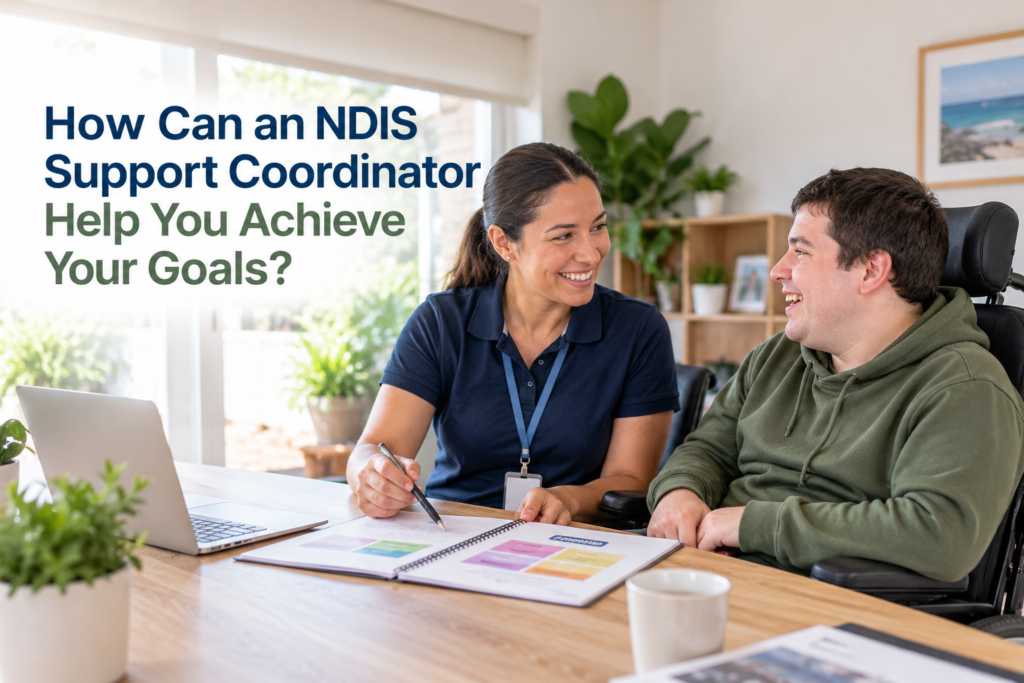
An NDIS support coordinator turns the funding in your plan into supports you can use each week. This guide covers what the role involves, the three levels, how to tell it is working, and how to choose one in Perth.
Your NDIS plan arrives with goals written into it. Learn to catch the bus alone. Join a weekly class. Move out of the family home.
Then the practical questions start. Which provider? Which budget pays? Who books the first session? That gap between plan and daily life is where an NDIS support coordinator works.
What does an NDIS support coordinator do?
Before diving into complex clinical assessments, every applicant must meet the scheme’s fundamental baseline rules. The National Disability Insurance Agency (NDIA) enforces strict requirements regarding your age and citizenship status before reviewing any applications.
First, you must be aged between 0 and 64 years old on the exact day you submit your complete application. If you are seeking support for a child under 9 years old, they will usually enter through the early childhood approach pathway. Individuals aged 65 and older are instead supported by the standard Australian aged care system.
Second, you must meet the residency guidelines, meaning you live in Australia permanently and hold valid citizenship or a permanent visa. Residents holding a Protected Special Category visa are also fully permitted to apply. You will need to provide formal identity checks and proof of address to verify this status.
Plan words you will hear
| Term | What it means |
|---|
| Core Supports | Everyday help such as support workers, household tasks, and transport |
| Capacity Building | Supports that build skills and independence, including support coordination |
| Capital Supports | Equipment, home modifications, and some accommodation funding such as Specialist Disability Accommodation (SDA) |
| Service agreement | A written agreement with a provider covering what they deliver, when, and the cost |
| Plan review | The meeting where the NDIS looks at how your plan worked and what should change |
The three levels of NDIS support coordination
NDIS support coordination comes in three levels. Your plan may name the level. If it does, that is the level you can purchase. If it does not, you can choose the level that suits your situation.
Level 1: Support connection
This level helps you understand your plan and link in with community, mainstream, and paid supports. It suits people who are new to the NDIS or already know what they want.
Level 2: Support coordination
Here the coordinator does hands-on work. They arrange services, keep providers talking to each other, and build your confidence in using your plan.
Level 3: Specialist support coordination
This level is for complex situations, such as when health, housing, or justice services all affect your supports. The NDIS expects a specialist coordinator to have suitable qualifications and experience. Your plan must include this level before it can be delivered.
Which level fits your situation?
| Level | Suits you when | Main focus |
|---|
| Support connection | You are new to the NDIS or already know what you want | Understanding your plan and linking with supports |
| Support coordination | You want hands-on help setting up and managing services | Arranging services, coordinating providers, building your skills |
| Specialist support coordination | Your situation is complex and spans several services | Resolving barriers in your support environment and keeping delivery consistent |
From goal to weekly supports: the goal-to-roster check
Goals feel big. Funding is spent in hours. A simple check turns one into the other.
For each of your NDIS participant goals, ask three questions:
- What needs to happen each week for this goal to move forward?
- Who will do each part: you, family, a community group, or a paid support worker?
- Which budget line pays for it, and how many hours does that buy?
Here is an illustrative example, written as a composite and not a client story. A participant in Perth wants to join a weekly art class. The weekly tasks are getting there, settling in, and meeting people. The class host runs the session, a support worker attends for the first few weeks, and a Core Supports line covers the worker’s time and the travel.
Once the answers are on paper, the coordinator can book the right people and see whether the budget stretches to the end of the plan. For a clearer understanding of how funding is allocated, read our guide to NDIS funding plans and support budgets.
Ask for a spend check every month or two. Support worker hours are billed as they are delivered. A slow start can leave a large balance that gets squeezed into the final months.
Where community participation and home goals fit
Many goals take place outside the house: clubs, volunteering, classes, time with friends. Explore our guide to NDIS social and community participation in Perth to learn more about support options for participating in community life. NDIS community participation support pays for a support worker to go with you, along with the travel around it.
A coordinator links these pieces together. They look for groups near your suburb, check transport, and make sure session times suit your routine.
Home and living goals work the same way. A coordinator can help you explore options such as Supported Independent Living (SIL), Specialist Disability Accommodation (SDA), and Individualised Living Options (ILO). Whether funding for each is in your plan depends on your circumstances, so the first step is reading what your plan says and arranging visits.
Here is a second composite example, again written for illustration. A young adult in Perth lives with family and wants a place of their own. The coordinator asks what matters: distance from family, how much support is needed by day and overnight, housemates or living alone, and how easily they can reach shops and transport. Then they arrange visits and pull together information for the planner. The funding decision stays with the NDIS.
How Achieve Disability Care approaches support coordination
Achieve Disability Care is a registered NDIS provider based in Balga, Perth. Conversations at Achieve start with your life, your routine, and what you want to change. The supports come after.
Achieve offers support coordination, plan management, and related NDIS guidance, alongside daily living support, community participation, accommodation, and community nursing. When your coordinator and your support team know the same Perth neighbourhoods and the same people, handovers move quickly.
You choose your providers. A coordinator should show you options across the sector, including services outside their own organisation, and then act on your decision.
For families, carers, and guardians
You can play a real part in coordination. Many participants invite a parent, carer, or guardian to meetings with the NDIS support coordinator, and the participant’s own wishes lead the conversation. Agree early on who receives messages, who signs service agreements, and how decisions are recorded.
Signs your NDIS support coordinator is working well
Good coordination is visible in everyday life. Look for these:
- You know which supports start when, and who delivers each one
- Your goals come up in conversation, and the paperwork follows
- You receive a short summary of what was done, as often as you agreed
- Problems are raised early, before a budget or a service stalls
If supports are weeks late to start, calls go unanswered, or you feel steered toward one provider, raise it with your coordinator first. If that does not help, use the provider’s complaints process. You can also contact the NDIS Quality and Safeguards Commission.
Getting support coordination into your plan
Some plans include support coordination and some do not. If yours does not, raise it at your plan review or ask for a change to your plan.
Bring specifics. Say which supports you have tried to arrange, where the process stalled, and how many providers you contacted. The NDIS decides what is reasonable and necessary, and clear examples give the planner something to assess.
Your next step
A goal moves forward when someone turns it into a weekly routine. Which goal in your plan has no provider attached yet? Start there.
Contact the Achieve Disability Care team in Balga. Bring your plan and a list of your goals, and the team will talk through what an NDIS support coordinator could do for you and how support coordination could fit your routine.
Ready to Turn Your NDIS Plan Into Supports?
Let Achieve Disability Care show you how an NDIS support coordinator can match your goals with the right providers, schedules, and budgets in Perth.
Frequently Asked Questions