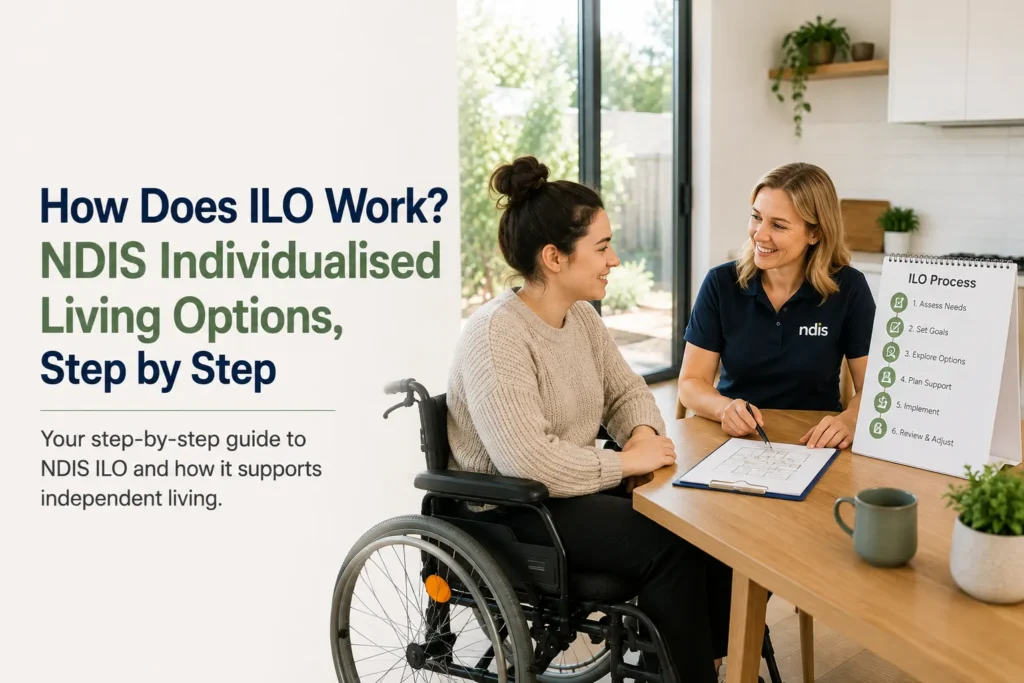
If you’ve already got a sense of what NDIS Individualised Living Options are and want to know what actually happens next, this is the guide for that.
This guide walks through the ILO process itself: what happens at each stage, roughly how long it takes to move from a first conversation to a working arrangement, and what to expect along the way.
What Is ILO?
NDIS Individualised Living Options, or ILO, are supports designed around your goals, preferences and support needs rather than a fixed housing model. ILO funds the support and planning behind a living arrangement — it does not fund the house, rent or mortgage itself.
How Does ILO Work?
The ILO process generally moves through two broad phases: exploration and design, followed by implementation and monitoring. Within those, a few clear stages tend to play out. It’s not instant, and it shouldn’t be. Getting the arrangement right the first time matters more than getting it done quickly.
As a rough guide, exploration and design can take anywhere from a few weeks to a few months, depending on how complex the arrangement is and how quickly NDIS approvals move. Implementation timelines vary just as much, since setting up a host arrangement is a different undertaking to adding drop-in support to a home you already live in.
1. Explore the participant’s goals
This is where a provider sits down with you (and family or support workers, if you want them involved) and talks through what you actually want. Do you want more independence? To live near people you trust? A quieter setup than what you have now? There’s no wrong answer here, but it needs to be specific enough to design around.
It helps to come into this conversation with a rough sense of your current NDIS plan and any existing “Home and Living” goals already in it, since that shapes what’s realistically on the table.
2. Explore living arrangements
Once your goals are clear, the conversation turns to practical options: living alone, sharing with a housemate, living with a host, or staying close to family. Your provider should walk you through the trade-offs of each rather than pushing you toward whichever is easiest to set up.
Identify support needs
This step maps out what daily support actually looks like, which varies from person to person. Personal care, help around the house, safety considerations, getting out into the community. Some of this is formal (paid) support, some might be informal support from family or friends, and the mix depends entirely on the participant’s own circumstances.
3. Design and implement the arrangement
Your provider puts together a proposal that reflects everything from the stages above, generally including a cost breakdown for submission to the NDIS. Once the proposed arrangement, funding and responsibilities have been confirmed, the provider can help put the agreed supports into practice. This might mean moving, or it might mean building new supports into where you already live.
4. Review and adjust the arrangement
An ILO setup isn’t meant to be static. As your goals or circumstances shift, the supports around you can shift too. Most providers build in a review point rather than waiting for something to go wrong first. Regular review keeps the arrangement working for you rather than becoming outdated.
What Living Arrangements Fit Into This Process?
The “explore living arrangements” stage above can lead to a few different setups: living with a host, sharing with a housemate, living independently with drop-in support, or staying near family with added formal support built in. Each has its own trade-offs around privacy, cost, and how much day-to-day contact you have with support workers.
We’ve covered these in detail, including how each one typically works in practice, in our comprehensive ILO guide.
Who May Consider ILO?
ILO tends to suit people who want more say in their living arrangement than a standard model offers, and whose NDIS plan includes goals around independent or alternative living. Having those goals is a starting point, not a guarantee. Whether ILO applies to your situation depends on your current plan, your assessed support needs, and a range of individual factors that a provider or planner can talk through with you.
If you’re unsure whether ILO is right for you, that’s a conversation worth having with a provider directly rather than guessing from a blog post.
What Does ILO Funding Actually Cover?
ILO funding under the NDIS covers the support and services around your living arrangement: the exploration and design work, and the ongoing implementation and monitoring once it’s set up. It does not pay for the house itself, rent, mortgage payments, utilities, groceries, or ordinary household expenses.
Those costs are generally separate from ILO support funding, and participants should confirm their individual costs and supports with the NDIS, plan manager, support coordinator or provider. Our broader guide to how NDIS funding can and can’t be used covers this distinction in more detail. What ILO funding does cover is the help that makes a chosen living arrangement workable and safe.
Where ILO Fits Alongside SIL and SDA
If you’re weighing up ILO against Supported Independent Living (SIL) or Specialist Disability Accommodation (SDA) rather than exploring the ILO process specifically, our ILO vs SIL comparison guide and the page to compare SIL, SDA, STA, MTA and ILO side by side both go into that in detail.
Ready to Start the ILO Process?
Starting the ILO process usually begins with a conversation, not paperwork. A provider will talk through your goals, your current NDIS plan, and what kind of living arrangement you’re picturing. From there, exploration and design can begin.
If you’re in Perth and want to talk through what the ILO process could look like for you, our team at Achieve Disability Care can walk you through exploring goals, considering living arrangements, and identifying support needs as a starting point.
Ready to Start Exploring Your ILO Options?
Achieve Disability Care can help you understand the ILO process, explore suitable living arrangements and discuss your support needs in Perth. Speak with our team about your goals and possible next steps.
Frequently Asked Questions